
AI Can Do the Task. But Who Understands What Matters?
 As artificial intelligence changes the way we work, perhaps the most important professional skills are the ones we’ve always struggled to describe.
Artificial intelligence can make an appointment.
It can identify available times, send invitations, issue confirmations and remind everyone when they need to turn up.
And that’s brilliant.
There are countless administrative transactions that technology can complete more efficiently than a human being.
I don’t think we should be frightened of that.
But after more than 35 years working as an Executive Assistant, I find myself asking a rather different question.
Just because technology can complete a task, does that mean it understands the decision behind it?
Because there’s an enormous difference between arranging a meeting and understanding whether that meeting should happen.
And I think that distinction takes us to the heart of a much bigger conversation about professional value.
The task is only what people can see
Consider an executive’s diary.
To somebody unfamiliar with the EA profession, diary management might appear fairly straightforward.
There are meetings.
There are available spaces.
You put one into the other.
Job done.
Except, of course, it isn’t.
An experienced EA is considering things that may never appear in the diary itself.
Does the meeting actually need to happen?
Does it need to happen today?
Could the matter be resolved another way?
Who needs to be involved?
What does the executive need to know beforehand?
What else is happening that day?
Does the conversation require preparation, reflection or recovery time?
Are there sensitivities, relationships or implications that aren’t immediately obvious?
And perhaps most importantly:
Is this the right decision for this particular person, in this particular situation, at this particular moment?
The visible task may take two minutes.
The judgement behind it may have taken 20 years to develop.
That’s the part we need to get better at recognising.
We’ve spent years describing the wrong things
I recently had an interesting conversation about the intangible value of the EA role.
We agreed that a job description is, in many respects, a task list.
It describes what needs to happen.
- Diary management.
- Meetings.
- Correspondence.
- Events.
- Governance.
- Travel.
- And yes, occasionally making a coffee. 😉
Those things matter.
But they don’t adequately explain why an executive values the judgement of one particular EA.
Why they seek their opinion.
Why they trust them to challenge a decision.
Why they rely upon them to understand the implications of something that hasn’t yet been said aloud.
Two people can complete broadly identical tasks and deliver very different levels of professional value.
Not necessarily because one is faster.
But because one understands something the other doesn’t yet know.
- The relationships.
- The history.
- The personalities.
- The consequences.
- The context.
That understanding develops through experience, observation, curiosity and trust.
And it’s extraordinarily difficult to capture in a list of responsibilities.
Technology is making the distinction more visible
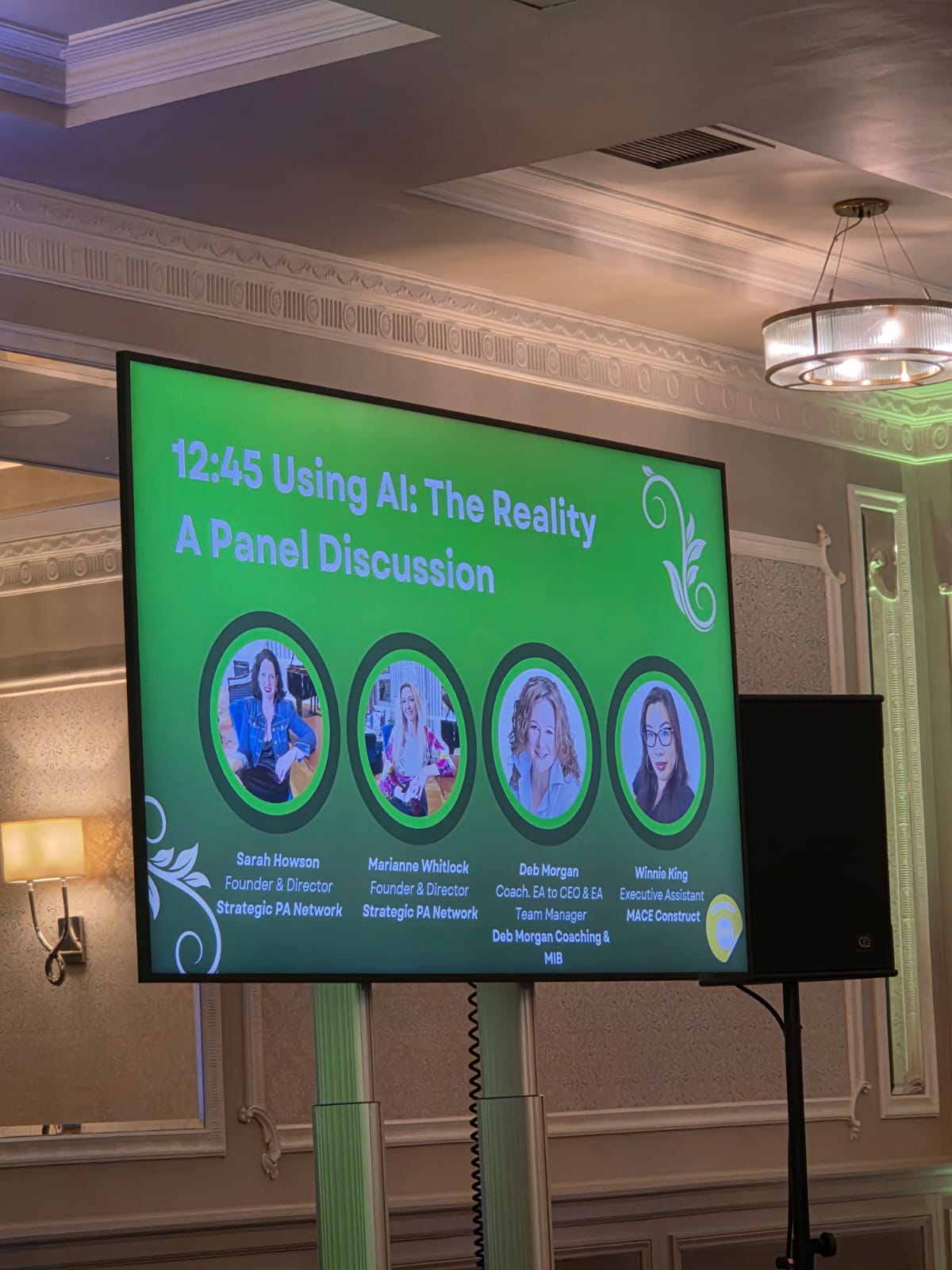
Next week I’m attending a two-day AI conference specifically designed for Executive Assistants.
I’m looking forward to it.
I’ve been experimenting with AI for well over a year, long before it became available to me in my workplace.
I wanted to understand it.
To explore what it could do.
To become familiar with its strengths and limitations.
And to consider how it might change the way I work.
I’m not attending because I want to become an AI specialist.
I’m attending because I believe understanding emerging technology is part of taking responsibility for my own professional development.
But I’m also interested in what happens when we stop asking technology to reproduce everything we currently do.
What if we use it to remove some of the routine work so that we have more capacity for the work requiring judgement?
What if the conversation shifts from:
How much time can AI save us?
To:
What could we contribute if we spent less time producing and more time thinking?
That’s an exciting possibility.
But it also requires us to become considerably better at articulating the value of that thinking.
Human judgement isn’t automatically good judgement
There’s an important qualification here.
I don’t believe that being human automatically makes somebody’s judgement superior.
People make mistakes.
We overlook information.
We become attached to familiar ways of working.
We make assumptions.
We can be influenced by emotion, habit and experience. Sometimes our accumulated knowledge becomes an advantage. Sometimes it creates blind spots.
Technology can help us challenge those assumptions.
It can offer alternatives. Highlight patterns. Summarise complex information. Help us examine different possibilities. And provide another perspective when we’re trying to work through something difficult.
I use AI in precisely that way.
- As a supportive tool.
- A sounding board.
- Something that helps me think more clearly.
But I don’t want it to remove my responsibility for thinking.
The objective isn’t to protect human judgement from technology. It’s to use technology to make human judgement better informed.
That requires curiosity.
Critical thinking.
An understanding of limitations.
And the confidence to question an answer, even when it arrives beautifully presented.
The skills we’ve called soft may be fundamental
There’s another part of this conversation that interests me.
For years, we’ve described capabilities such as communication, emotional intelligence, adaptability and relationship management as soft skills.
I’ve never particularly liked that expression.
There’s nothing soft about knowing how to challenge a senior executive without undermining their confidence.
There’s nothing soft about recognising that a technically correct message is entirely inappropriate for the person receiving it.
There’s nothing soft about managing a difficult conversation, recognising unspoken concerns or creating trust between people with competing priorities.
Those things can be difficult.
They require practice.
They require self-awareness.
And they can make an enormous difference to organisational effectiveness.
I’ve recently delivered presentation-skills workshops in my workplace. The participants already had considerable subject expertise. They didn’t need somebody to teach them more about their specialist subjects. They needed support in communicating what they knew.
In taking up space.
In projecting confidence.
In connecting with an audience.
Because knowledge that cannot be communicated effectively may never achieve the impact it deserves.
And I think the same principle applies to the EA profession.
Our value isn’t simply in what we know or what we produce.
It’s also in how we apply that knowledge to the people and situations around us.
Perhaps the future requires a different kind of confidence
I don’t know precisely what the EA profession will look like in ten years.
Nobody does.
Technology will continue to develop.
Some tasks will change.
Some roles may disappear.
Others will evolve.
And entirely new opportunities may emerge.
But I don’t believe the answer is to spend the next decade desperately trying to become indispensable.
I’d rather become adaptable.
Curious.
Well informed.
Confident in the judgement I’ve developed, but willing to challenge it.
Comfortable using technology without handing over responsibility for every decision.
And capable of recognising that my professional value extends beyond the tasks written on my job description.
Because perhaps the greatest opportunity AI presents isn’t simply doing more work in less time.
Perhaps it’s encouraging us to recognise the value of the work that was never particularly visible in the first place.
The thinking.
The judgement.
The context.
The relationships.
The decisions.
The understanding.
The human contribution.
And perhaps, as technology becomes increasingly capable of completing the task, we’ll finally become better at recognising the professional value of knowing whether the task should be done at all.
A question to take away
Think about your own professional contribution.
What decisions do you make every day that look simple to somebody watching from the outside?
What knowledge, experience or judgement sits behind those decisions?
And how often do you recognise that as valuable work?
Because perhaps the next stage of your professional development isn’t simply learning how to do more.
Perhaps it’s becoming more confident in articulating the value of what you already understand.